

The Merchant Exodus: An Existential Challenge
The numbers are striking. Over 40 percent of small and mid-sized merchants are considering switching from traditional banks to PayTechs, according to Capgemini's World Payments Report 2026. This isn't merchant dissatisfaction with banking services broadly it's merchant abandonment of payment services specifically. Companies like Square, Zettle, Toast, and Checkout are capturing market share that banks historically dominated.
The global merchant acquiring market is projected to reach $41.75 trillion by 2026, with explosive growth in embedded finance and real-time payments. The business case for merchant services is compelling: research shows that offering merchant services to a small or mid-sized business (SMB) results in an 11 percent increase in monthly average deposit balances, a 13 percent rise in product adoption rates, and customer relationships that last approximately 10 percent longer.
Yet banks are losing precisely this opportunity to capture banking relationships that could triple payment acquiring revenue through cross-selling. The question isn't whether banks can afford to modernise payment infrastructure. It's whether they can afford not to.
Why Banks Are Losing (And Why They Don't Have To)
The fundamental problem isn't competition on price or regulatory advantage. Banks face a structural disadvantage: they pay 2.3 times more to onboard merchants than PayTech firms do. But economics alone don't explain merchant defection.
The real reasons merchants are switching:
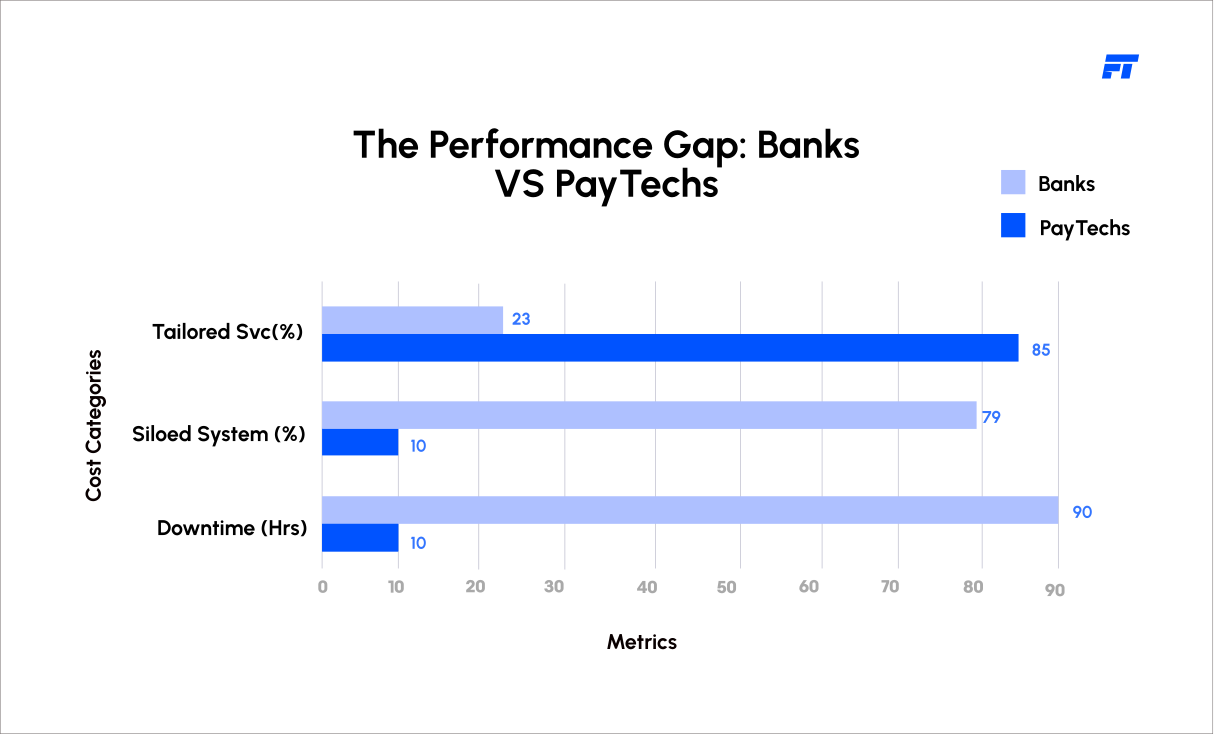
- Fragmented customer experience: Banks struggle with operational silos, creating multiple logins, fragmented experiences, and subpar customer experience compared to agile PayTechs.
- Legacy infrastructure: While 70 percent of PayTech firms deploy payment orchestration platforms, only 47 percent of banks have achieved comparable capability.
- Vertical specialisation gap: Vertical SaaS solutions from PayTechs address specific merchant needs (restaurants, retailers, subscription services) that banks treat as generic segments.
- Speed disadvantage: Small merchants pay 30 to 50 basis points more with banks than large retailers, yet receive slower, less flexible service.
- Strategic abandonment: Many banks consciously shifted away from merchant acquiring toward issuing, which offers higher margins and cross-selling potential, creating space for PayTechs to win.
Critically, this is a modernisation problem, not an existence problem. Banks possess inherent competitive advantages that PayTechs cannot easily replicate.
Why Banks Still Win (If They Execute)
Banks possess three structural advantages that, if properly leveraged, are insurmountable for PayTechs:
- Trust and regulatory presence:
Customers are more inclined to trust innovative technology when associated with a bank rather than an unfamiliar fintech. Regulatory certainty, capital adequacy, and deposit insurance create institutional trust that PayTechs must spend years building. - Existing merchant relationships:
Banks maintain established relationships with SMBs through their sales teams and call centres, providing multichannel engagement that fintechs typically cannot match. This is not a theoretical advantage, it is a distribution channel ready to activate. - Scale economics:
Banks operate at scale enabling competitive pricing, whereas PayTechs operate on thinner margins constrained by rapid growth investment. For large merchants, banks should have pricing power.
Yet these advantages are only valuable if banks can deliver modern customer experience. This requires infrastructure modernisation, not just competitive positioning.
Three Strategic Pillars for Banks to Recapture Merchants
Pillar One: API-First Infrastructure and Payment Orchestration
The most crucial competitive gap is infrastructure. PayTechs winning merchant share have deployed payment orchestration at 70 percent penetration, compared to 47 percent for banks. Payment orchestration enables merchants to route transactions intelligently across multiple providers based on cost, approval likelihood, and settlement speed.
Banks that modernise to API-first payment architecture gain two critical capabilities: (1) Ability to integrate with third-party providers without rebuilding core infrastructure, and (2) Speed to deploy new payment products (real-time, wallet-based, embedded finance) that merchants increasingly demand.
This isn't theoretical. Global payments revenues are growing at 4 percent annually, with the market expected to reach $3.0 trillion by 2029. Real-time payment infrastructure is expanding globally through mandates (EU instant payments) and government initiatives (Brazil's PIX). Banks with modern infrastructure will capture this growth. Those without will watch PayTechs do so.
Pillar Two: Strategic ISV Partnerships and Embedded Finance
Banks cannot compete with PayTechs by building vertically integrated solutions alone. Instead, strategic partnerships with independent software vendors (ISVs) and payment facilitators enable banks to offer bespoke solutions tailored to specific merchant segments.
The market opportunity is enormous. 65 to 70 percent of net merchant acquiring revenue is driven by small and mid-sized businesses, yet SMBs increasingly gravitate toward integrated software vendors for comprehensive payment solutions.
For banks, this means co-creating payment solutions with ISVs rather than attempting to build proprietary vertical solutions. Partnerships enable acquirers to expand into vertical markets (e-commerce, subscription services, nonprofits) that demand tailored solutions while leveraging each partner's strengths.
Banks that treat ISV partnerships as strategic (not transactional) will position themselves as infrastructure providers enabling innovation rather than competitors attempting to match PayTech agility.
Pillar Three: Banking-as-a-Service and Experience-as-a-Service
Banks increasingly turn to fintech partnerships through Banking-as-a-Service (BaaS) models to expand ecosystems and maintain competitiveness. Rather than viewing fintechs as competitors, forward-thinking banks recognise that BaaS expected to reach $7 trillion by 2030, representing enormous opportunity for banks willing to expose core infrastructure through APIs.
Similarly, Experience-as-a-Service (EaaS) enables banks to overcome silos and provide integrated experiences akin to those of fintechs, combined with inherent advantages. Banks that deconstruct siloed payment experiences and rebuild them through EaaS models gain competitive advantage without requiring wholesale infrastructure replacement.
Strategic Impact for Executive Leadership
Understanding why merchants defect to PayTechs and what strategic responses are required creates competitive advantage across three dimensions:
- Revenue acceleration:
The potential revenue from broader business banking services to merchants is estimated at three times that of merchant acquiring alone. Banks that modernise payment infrastructure recapture merchant relationships, then cross-sell deposit, credit, and treasury services. This is not marginal revenue uplift—it is transformational. - Operational efficiency:
Modernised payment platforms streamline operations through automation and straight-through processing, reducing manual intervention and errors while improving transaction speed and reducing operational costs. Banks investing in Payments-as-a-Service and modern infrastructure achieve cost structures competitive with PayTechs whilst maintaining regulatory advantages. - Competitive resilience:
Banks with modern payment infrastructure, ISV partnerships, and BaaS exposure create resilience against PayTech disruption and enable rapid innovation response. Rather than viewing payment infrastructure as operational overhead, forward-thinking banks position it as strategic competitive advantage.
The Path Forward: Modernisation as Imperative
Banks are not losing merchants to PayTechs because they are obsolete institutions. They are losing because they have not modernised payment infrastructure to deliver the customer experience, speed, and flexibility that merchants increasingly demand.
The winning bank strategy combines inherent competitive advantages (scale, trust, relationships) with modern infrastructure (API-first, payment orchestration, real-time payments), strategic partnerships (ISVs, payment facilitators), and flexible business models (BaaS, EaaS). This is not a 10-year transformation initiative it is a 2-3 year modernisation imperative requiring executive prioritisation and investment.
The merchant acquiring market is reshaping before us. PayTechs are winning not because they are better banks. They are winning because they were built modern. Banks that modernise payment infrastructure now will recapture merchant share and build decades-long relationships worth billions in cross-sell opportunity. Those that delay will watch that opportunity migrate to platforms that should never have captured it.
Ready to explore how Fyscal Technologies can help you achieve this?
Book a Strategy Call →